
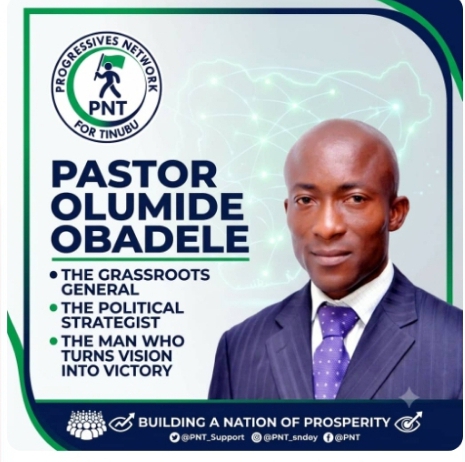
A Tribute to an Uncommon Mobiliser, a Dependable Leader and a Political Strategist of Exceptional Pedigree
In the theatre of politics, where words are often louder than deeds and promises sometimes travel faster than performance, there are still a few men whose names command attention because their footprints speak before they do.
Pastor Olumide Obadele, Director-General of the Progressive Network for Tinubu (PNT), belongs to that rare breed.
Without mincing words, Pastor Obadele is a grassroots mobiliser, political strategist, goal-getter and bridge-builder whose political relevance is increasingly defined not by the volume of his rhetoric but by the depth of his organisational capacity, the reach of his network and the consistency of his commitment.
He is, in every meaningful sense, a man who understands the grammar of grassroots politics.
And that grammar is simple: listen to the people, reach the people, educate the people, organise the people and earn their confidence.
That is precisely where Pastor Obadele has distinguished himself.
THE GRASSROOTS GENERAL
Across the political landscape of Ondo State, the Progressive Network for Tinubu has continued to expand its organisational footprint. Reports indicate that PNT, under Pastor Obadele’s leadership, has built structures across the state’s local governments, wards and polling units, with an ambitious mobilisation strategy ahead of the 2027 general elections.
This is not merely politics as usual.
It is politics from the bottom up.
It is the politics of engagement rather than empty grandstanding; the politics of persuasion rather than coercion; the politics of information rather than misinformation.
Pastor Obadele understands a fundamental truth about democracy:
“A political movement becomes powerful when its message reaches the people and its structure remains rooted among the people.”
Through PNT, the electorate is being engaged on the administration and leadership of His Excellency, Senator Asiwaju Bola Ahmed Tinubu, GCFR, with the organisation advocating his return to office in 2027.
Whether one agrees politically with that position or not, the organisational architecture behind the advocacy is unmistakable. PNT has publicly declared its ambition to deepen its presence down to polling-unit level, demonstrating an understanding that elections are ultimately won not merely on television screens or social-media platforms, but in communities, streets, wards and polling units.
That is the hallmark of a strategist.
A STRATEGIST WHO KNOWS THE TERRAIN
Pastor Olumide Obadele is not merely participating in politics; he is studying its terrain.
He recognises that political victory is the product of preparation, organisation, communication and people-to-people engagement.
His approach reflects the wisdom behind the famous maxim:
“Plans are nothing; planning is everything.”
In the political ecosystem, where structures rise and collapse with alarming speed, the ability to create a network that can penetrate the grassroots is no small achievement.
It requires patience.
It requires discipline.
It requires trust.
And, above all, it requires leadership.
Recent reporting has also captured Pastor Obadele speaking on broader political questions in Ondo, including the importance of competence and capacity in political leadership.
That intervention is revealing.
It shows a political mind that understands that leadership should transcend the distribution of positions and become a contest of ideas, competence, capacity and service.
THE OBADELE FACTOR
There is something particularly compelling about Pastor Obadele’s political persona: he combines conviction with organisation.
Many people can make political declarations.
Few can convert declarations into structures.
Many can gather crowds.
Few can build sustainable grassroots networks.
Many can speak about the people.
Few consistently make the people the centrepiece of their political engagement.
That is where the Obadele factor becomes significant.
His leadership of PNT has increasingly placed him among the voices seeking to build a formidable grassroots support base for President Tinubu in Ondo State. Earlier reports quoted him describing Tinubu as a leader who was not “trial-and-error” and highlighting what he regarded as major policy decisions of the administration.
That conviction has translated into organisation.
And organisation is the bridge between political aspiration and political achievement.
WHEN POLITICS TOUCHES LIVES
Perhaps even more important is the connection between political organisation and the tangible welfare of ordinary citizens.
The grassroots are not abstract statistics.
They are mothers.
They are fathers.
They are young people.
They are traders.
They are artisans.
They are farmers.
They are widows.
They are elderly citizens.
They are vulnerable families trying to survive the difficult realities of everyday life.
It is against this backdrop that the various interventions associated with Hon. Dr. Olubunmi Tunji-Ojo (BTO), Minister of the Interior, have resonated among sections of the Ondo grassroots.
Reports have documented interventions involving food and financial assistance, including support for elderly persons and relief for flood victims in Ondo. One reported Christmas and Salah intervention provided rice and cash support to many elderly beneficiaries, while another report documented cash assistance for flood victims in Ondo South.
Through political networks and grassroots structures, such interventions can become more than announcements from distant corridors of government; they can become experiences felt directly by ordinary citizens.
And that is where Pastor Obadele’s grassroots role becomes significant.
Leadership is ultimately measured by impact.
A political structure that educates the electorate is valuable.
A political structure that mobilises the electorate is strategic.
But a political structure that also helps connect people to meaningful interventions is people-centred politics in action.
A MAN OF INTEGRITY
Yet, beyond politics, strategy and mobilisation, there is another quality that stands out in the description of Pastor Olumide Obadele:
Integrity.
In an environment where political loyalty can sometimes be transactional and public service can be clouded by personal interests, integrity remains the most precious political currency.
A man’s pedigree may open the door.
His connections may put him at the table.
His title may command respect.
But only character can sustain influence.
Pastor Obadele’s reputation for uncommon integrity and dependability is therefore not merely a flattering description; it represents the foundation upon which enduring leadership must be built.
As the timeless saying goes:
“Character is higher than intellect.”
And another enduring leadership principle says:
“The true test of leadership is not how many people follow you, but how many lives become better because you led.”
That is the standard by which every political leader should ultimately be judged.
THE RELIABLE HAND
In political circles, reliability is priceless.
The man who can be counted upon when the spotlight disappears is more valuable than the man who shines only when the cameras are rolling.
Pastor Obadele represents, to his admirers and political associates, a reliable hand in the machinery of grassroots mobilisation.
He is the kind of political actor who understands that victory is rarely accidental.
It is engineered.
It is coordinated.
It is pursued relentlessly.
And it is secured through people.
This is why his leadership of PNT deserves recognition as more than an ordinary political assignment.
It is a responsibility that demands vision, stamina, persuasion, strategic intelligence and organisational discipline.
THE MAN, THE MISSION AND THE MOMENT
As the political horizon gradually shifts toward 2027, the significance of grassroots structures will continue to grow.
The electorate will demand explanations.
Communities will demand engagement.
Political movements will demand organisation.
And leaders will be judged increasingly by their ability to transform slogans into structures and structures into measurable results.
Pastor Olumide Obadele appears prepared for that challenge.
His message is clear.
His political machinery is expanding.
His grassroots orientation is unmistakable.
His commitment is unwavering.
And his ambition for PNT is audacious.
From the local government to the ward, from the ward to the polling unit, from the polling unit to the ballot box — the architecture of political mobilisation is being built.
That is the Obadele story.
A FITTING SALUTE
So, what manner of man is Pastor Olumide Obadele?
A mobiliser with the heart of a servant.
A strategist with the mind of a chess master.
A political organiser with the energy of a marathoner.
A goal-getter with the discipline to pursue results.
A bridge-builder with an instinct for people.
A dependable ally with uncommon integrity.
And above all, a leader whose political relevance is increasingly being measured by the strength of the grassroots structures around him.
In the words of an old African proverb:
“If you want to go fast, go alone. If you want to go far, go together.”
Pastor Obadele’s political journey demonstrates an appreciation of that timeless wisdom.
He is building teams.
He is building structures.
He is building relationships.
He is building confidence.
And, in his own way, he is building a political movement that seeks to make its voice heard from the grassroots of Ondo State to the national political arena.
Pastor Olumide Obadele is not merely preparing for an election; he is building the machinery of persuasion.
And if political leadership is about vision, mobilisation, loyalty, strategy and service, then his name deserves a prominent place in the conversation.
A great man.
A reliable man.
A dependable man.
A grassroots general.
A political strategist.
A goal-getter.
A man of uncommon integrity and remarkable pedigree.
That is the Obadele standard.
And that is why his political journey deserves not only attention, but a standing ovation.
Powered By:
PNT MEDIA.
